Behind the Mic: Rob Archer
 Rob Archer is a veteran broadcaster, voice talent, writer, and podcaster. Best known for his decade anchoring KNX News in Los Angeles, Rob has worked across virtually every format in radio, from alternative rock to adult contemporary to talk and all-news. If you want a voice with experience, versatility, credibility, and personality, Rob delivers.
What radio VO work have you done in the past?
I’ve spent nearly 30 years working in Los Angeles radio, most recently as a news anchor at KNX News 97.1 FM and previously at KFI. Along the way I’ve done imaging, promos, production, narration, and commercial work for stations in multiple formats. I’ve also worked on syndicated formats and network programming through Westwood One and Dial Global.
What are you up to presently?
I’m currently working as a freelance voice talent, writer, podcaster, and content creator. In addition to voice work, I produce the Archer’s Line newsletter and co-host a couple of podcasts: Archer & Feldman, where I team up with one of my old KNX colleagues, which focuses on media, journalism, and broadcasting; and Disciples of Democracy with my friend Jack Messenger.
Check out Rob’s demos!
What do you love about your job?
Every day is different. One day I’m voicing a station promo, the next I’m writing an article, recording a podcast, or producing a piece of audio. I still enjoy the challenge of communicating something clearly and connecting with an audience through a microphone.
And that’s always been the main thing for me: Talking into a microphone and knowing someone can hear me. Everything I’ve done in my career centers around it.
How did you get started as a VO actor?
Like a lot of radio people, I sort of backed into it. I started in music radio, then moved into programming, production, and eventually news.
Many years ago, I auditioned and was in the final round to be the main narration voice and main character in an animated show about a big-city cop who goes to a small town to be the police chief. He’s a blowhard, know-it-all. The producers liked my Phil Hartman-esque take. The show didn’t sell. I can’t confirm this, but some of the same people eventually got a show on the air called Archer. I like to think it was named after me. Pretty sure it wasn’t, but hey, I like telling myself that!
What was your first gig? Any memorable ones since then?
My first paid radio job was at a small station in my hometown in South Florida. I was still in high school when I started, and eventually got my own afternoon show, then mornings. I lived 1.7 miles from my house. Imagine the commute!
As for memorable gigs, anchoring breaking news in Los Angeles during major wildfires, earthquakes, elections, and other major events stands out. Those are the moments when your voice becomes a lifeline for listeners. There was the day that Queen Elizabeth died, and I know so much about British royal history; I was really in my element, spinning off facts and anecdotes that no one else at the station knew.
Who are your VO idols/mentors?
I’ve always admired great communicators more than traditional “announcer voices.” But voices that stand out to me – the amazing H. Jon Benjamin, who voiced the aforementioned Archer. Great voice, great delivery. I wanted him badly to do the imaging for a rock format I created called Meta (in the days before Facebook took the name). Couldn’t make it happen, much to my regret. I wound up doing some of the imaging myself.
Another voice I love is Keith Olbermann. The style. The sharpness. The attitude. The writing.
If you weren’t doing voiceover, what else do you think you’d be doing for a career?
Probably writing full-time. I’ve always loved storytelling, whether it’s journalism, essays, fiction, or music. But even doing that, I’ve got to be talking into a microphone. Sometimes, I think that’s the only reason I exist. If I could never work in broadcasting again, I’d get a gig at a big store so I could make announcements. And I’d be great at it.
What did it feel like the first time you heard your voice on the radio/television?
It’s been so long, I don’t really recall. I know that many other people think it’s weird when they hear themselves, because how your voice sounds inside your skull is very different than how it sounds in others’ ears. I’m so used to it now that when I hear my own voice, I’m thinking of ways I could sound better, different inflections, and so on.
How has new technology changed the way you work?
Technology has made it possible to work from almost anywhere. What once required a production room and engineering staff can now be done from a home studio. It’s also opened opportunities to work with clients around the world.
What gear do you use on the road? In your studio?
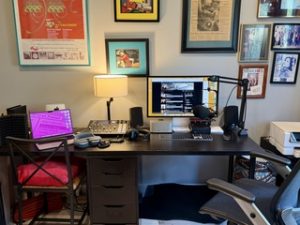
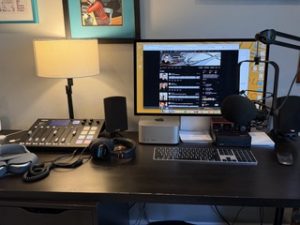
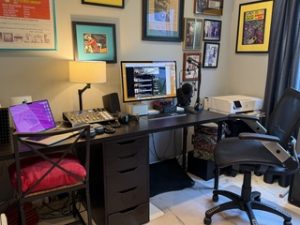
My studio setup centers around an EV RE320 through a Røde mixer and a streamlined digital workflow through my Apple Mac Studio. On the road, I keep things simple and portable so I can record broadcast-quality audio wherever I happen to be.
Rob’s Studio Setup!
Which production system do you use and why? Any favorite plugins?
I’m comfortable in several systems, but I spend most of my voiceover time in Audacity, because it’s basic but still is able to employ any plug-ins I need. It’s wonderful for basic voice work. But I also make a lot of use of Apple’s Logic Pro – in addition to recording my voice, I’ve written and recorded a lot of music at home. There’s a small part of my soul that wanted to be a rock star, and it never died. As for plugins, I tend to favor tools that solve problems cleanly rather than flashy processing. You can go down so many rabbit holes with processing that you get lost if you’re not careful.
Have you ever had a voice coach? Would you recommend it?
Absolutely, I would recommend it. Even experienced talent benefits from coaching. A good coach can help you identify habits you don’t realize you have and expand your range.
How do you schedule/prioritize your work? How much time do you spend auditioning for new work?
Client work always comes first. Beyond that, consistency matters. I set aside dedicated time for outreach, auditions, and creative projects instead of trying to squeeze them in whenever I have a spare moment. I keep myself very busy. It’s how I keep those demons at bay.
How do you market your services to potential clients?
Relationships. Most opportunities in broadcasting and voice work come from people who know your work, trust your professionalism, and know you’ll deliver when needed. And there’s always the friend-of-a-friend aspect, so above all else, you must network!
But then there’s Benztown! A recognized and respected brand that can get your voice in front of more clients than you could ever do otherwise.
When it comes to VO work, studio & gear, what are your most ingenious methods/discoveries for saving time and cash?
Don’t chase gear. Invest in a solid microphone, a quiet recording environment, and learn how to use what you already own. Performance matters more than equipment.
What is the best voice processing trick or voice-over technique everyone should know?
Talk to one person. Not an audience. The moment you do that, your reads become more natural and believable. As for processing, don’t go crazy unless the job calls for it. And most of the time, the stuff you make for a client, they’re going to want to do their own processing to fit their audio chain. A little frequency sweetening, a little bit of compression/limiting… for most of what you do, you don’t need more than that.
Do you have a different approach to reading radio imaging copy as opposed to TV/Radio commercial ads?
Definitely. Imaging is about attitude, momentum, and brand identity. Commercials are about persuasion and connection. They’re different muscles, and each requires a different mindset.
Can you offer 3 helpful tips for newbies trying to make it in the voice-over industry?
- Learn to take direction without taking it personally.
- Focus on sounding authentic rather than sounding like a “voice actor.”
- Be reliable. Talent gets you hired. Reliability gets you rehired.
If you could go back in time and hang out in any decade, which one would you go back to and why?
The 1960s. The music, the space race, the social change, the birth of modern broadcasting — it was one of the most fascinating decades in American history. But mostly for the furniture. That mid-century aesthetic gets me going. Maybe it’s because it was the furniture I knew when I was a wee lad.
Favorite 2 pizza toppings?
Bacon and bacon.
If you could invite one person to dinner, living or dead, who would it be?
Edward R. Murrow. I’d love to hear what he would think about journalism, media, and broadcasting today. I bet he’d cuss a lot.
If he wasn’t available, Kurt Vonnegut. My writing god.
If he wasn’t available, Keith Olbermann. Just for the stories.
If he wasn’t available, Hilary Mantel, for the trilogy she wrote about one of my favorite historical figures, Thomas Cromwell.
If she wasn’t available, Christopher Nolan, because I’m such a fanboy. But it would be a short dinner, because I’d be tongue-tied.
Connect with Rob:



;)


;)